Is Eventbrite really helping you put bums on seats?

After a year of running C90 Community Chorus, I started getting curious about how much Eventbrite was really doing to drive ticket sales, or whether it was just providing a virtual box office.
After all, there are plenty of other ticketing platforms, many of which are far easier to use than Eventbrite!
But when I ran the numbers, I discovered Eventbrite could take some credit for around one in five of our tickets. Let's dig into that in more detail.
Why use a ticketing platform, and not let people just turn up?
Offering tickets helps answer a few important questions:
- How many people can you jam in a room before it becomes a fire hazard?
- How do you know if your marketing or sales plan is working?
- How do you remind people when your next event is on?
For about a year I ran the Birmingham chapter of Ignite Talks, an evening of fun, fast-paced PowerPoint presentations (a bit like TEDx on speed).
The biggest mistake I made was not collecting contact details from ticket holders. It was a long time ago now, but I wasn't paying attention to how tickets were being offered. Some might've come through the venue, others from the website.
That meant that spreading the word about each night of talks was like starting a marketing campaign from scratch.
A ticketing platform can help solve that problem, but only if you understand which part of the work it's actually doing for you.
My plea to the audience of Ignite Brum #3 to help spread the word (as if it were their responsibility)
My belief is that a lot of interesting things die in Birmingham because we're great at starting them, putting them on, and bringing our friends along... but we think that'll provide enough steam to get us to the next one.
The unhappy truth is that marketing – dirty word as it might feel – is as essential to your event as the venue, the agenda, and the signage.
So how does Eventbrite (specifically) help with marketing?
When I ran the numbers across my events, I was surprised by how many people had found them by browsing or searching Eventbrite, and not through social media or email campaigns.
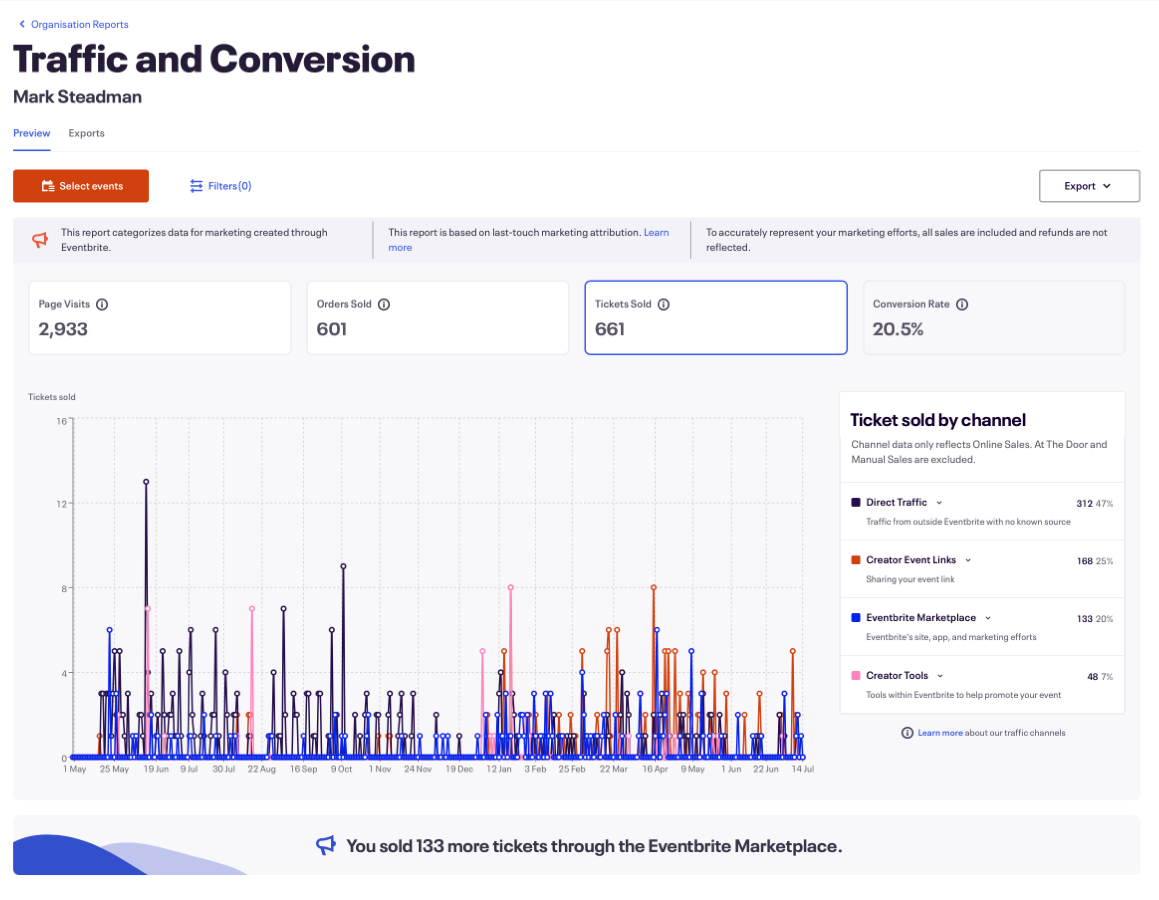
It turns out 20% of ticket sales were through Eventbrite's "marketplace"; its listing and search facilities. Because Eventbrite isn't simply a box office: it's a public-facing what's-on guide people browse when they're looking for stuff to do in their local area.
Now, this doesn't tell the whole story. Some people will have searched Eventbrite for "C90" or "Stirchley Write Club" because they were already familiar with it, or a friend had told them. That's a win in the word-of-mouth column, but Eventbrite takes the credit.
But almost half of the people who found us through Eventbrite did so by browsing events in their local area. So that's a clear win for Eventbrite, and reason enough to keep listing with them.
How does this stack up against other ticketing providers?
I've always had a soft spot for Tito, ever since I was introduced to it over 10 years ago. They're an Irish firm who specialise in making the ticket booking experience pleasant, and the organisation of your event relatively painless. But they don't support recurring events.
Ticket Tailor has been rising in the ranks recently. Their purchase flow is nice and simple, and their backend is a lot less clunky than Eventbrite.
Meetup used to be great, but they're getting increasingly cloying with their need to hijack your attention away with popups and "flash sales". They're also expensive, but they have good cachet when it comes to recurring, community-based events.
But what Tito and Ticket Tailor lack is that crucial public-facing what’s-on guide. Meetup does have local event listings, but it's more focused on recruiting you as an organiser. Eventbrite is not only a ticketing provider but a virtual pin board, with lots of local goings-on Blu-Tacked up for people to check out.
When a ticket sold is not a bum on a seat
If, like me, you list your events for free on Eventbrite, you'll know of the disparity between the number of tickets sold and the number of people who show up.
Now that C90 is such a regular fixture, I often find more people come through the door than have bought tickets. But I'm accustomed to a drop-off rate of around 25-50%. That's because the level of investment in a free event is next to nothing.
Even for paid events you can expect to see fewer people turn up, but the disparity is much smaller.
So remember that a ticket "sale" for a free event is really just an expression of intent. It's super useful data, provided you've captured their email address, but it's not a wholly reliable indicator of capacity. That’s why, allowing for likely no-shows, I routinely release 20% more tickets than the room can seat.
How to generate your own report
If you've been running a regular event with Eventbrite, you might be sitting on some useful data.
- Once logged in to Eventbrite, you can head to the Reporting section.
- Under Marketing, you'll find a button for the Traffic and Conversion report. Click that, select your events, and hit Generate report.
- Click the Filters link (next to the Select events button) and make sure the date range is set to "All time". Then hit Generate report again.
- Look for the "Eventbrite marketplace" channel next to the graph. You can expand that box to get some more detail on who searched for your event vs who browsed the Eventbrite website.
Some useful things to know
- Ticket sales and orders are listed separately, because a single order might contain multiple tickets. For this report, “Tickets sold” is the more useful number, as it represents potential attendees rather than transactions.
- This works whether your event is free (as all of mine are), or whether Eventbrite processes payments for you. A sale is still a sale even if no money changes hands.
- "Direct traffic" means someone came directly to your event's listing page, most likely by clicking a link from another website.
- Similarly, "Creator event links" are links people follow from other sources, like email and social media. So they kind of belong in the same bucket as "Direct traffic".
- If you see any numbers against "Creator tools", that might mean you've embedded an Eventbrite booking page into your website, or that someone's found your Eventbrite profile and followed through to the checkout process from there.
What does your report say?
I'd love to know how my numbers stack up to yours. If you're up for sharing percentages (not absolute numbers), drop them in the comments below with a link to your event, and we'll see if we can build a clearer picture together.
Member discussion